2026 Tsinghua PBCSF Global Finance Forum | “Report and Achievement Release” Thematic Panel
From May 17 to 20, 2026, the 2026 Tsinghua PBCSF Global Finance Forum was held in Chengdu. At the “Report and Achievement Release” thematic panel, six major reports and new books were successively released, focusing on frontier topics including international monetary system reform, global financial stability, AI application in insurance, financial innovation in urban village regeneration, and financial regulatory theory, collectively presenting the latest research outcomes in relevant fields.
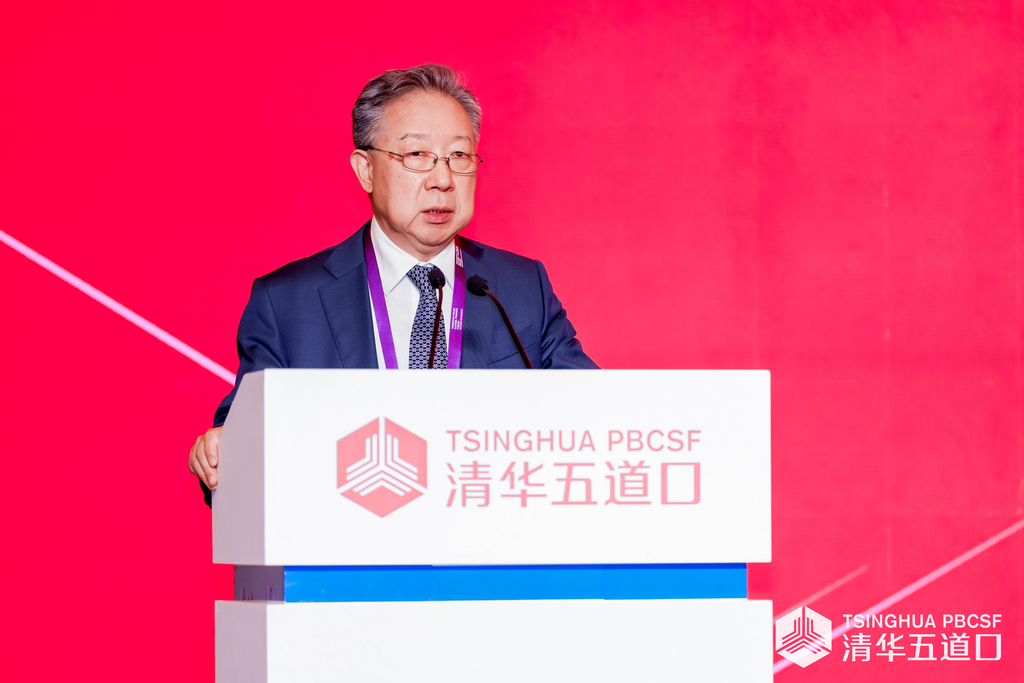
Photo: Zhang Liqing
Restructuring and Response: From the Bretton Woods System to a New Global Monetary System
Zhang Liqing, Director of the International Financial Research Center at Central University of Finance and Economics, released the new book Restructuring and Response: From the Bretton Woods System to a New Global Monetary System. The book was led by Zhu Min, former Deputy Managing Director of the International Monetary Fund and former Deputy Governor of the People’s Bank of China, and completed under the auspices of the PBC School of Finance, Tsinghua University, and the Global Economic Governance 50 Forum. Zhang pointed out that the Bretton Woods system, established in July 1944, successfully avoided the “beggar-thy-neighbor” nationalist economic policies prevalent during the Great Depression, effectively promoted global economic growth and financial stability, and was described by an IMF historian as “the most respected name in international monetary history, perhaps in economic history.” However, the United States often prioritized its own interests and closed the gold window in 1971 due to excessively high policy coordination costs, leading to the collapse of the system.
The current “post-Bretton Woods system” is centered on the U.S. dollar, suffering from the Triffin dilemma and the new Triffin dilemma, with the dollar’s excessive privileges causing global financial turmoil. Proposals such as creating a single world currency or returning to the gold standard lack practical feasibility. A multi-currency reserve system is a relatively realistic second-best choice, but it requires more diversified governance structures of the IMF and the World Bank. Zhang analyzed that due to factors such as the declining share of US GDP in the world, rising government debt (124% of GDP in 2025), net external liabilities reaching 90% of GDP, dollar weaponization, and unilateralist policies, the dollar’s dominant position will continue to decline. In the long run, the renminbi will become an important part of a diversified reserve system, but internationalization is a market-driven process. At present, China can appropriately accelerate capital account opening, expand two-way opening of the government bond market, actively promote the development of the offshore renminbi market, and tap the potential for cooperation with Global South countries. Regarding the impact of stablecoins and AI, Zhang argued that in the short term, stablecoin issuance may generate demand for US Treasury bonds and slow the dollar’s decline, but in the long term it cannot avoid the constraints of the new Triffin dilemma.
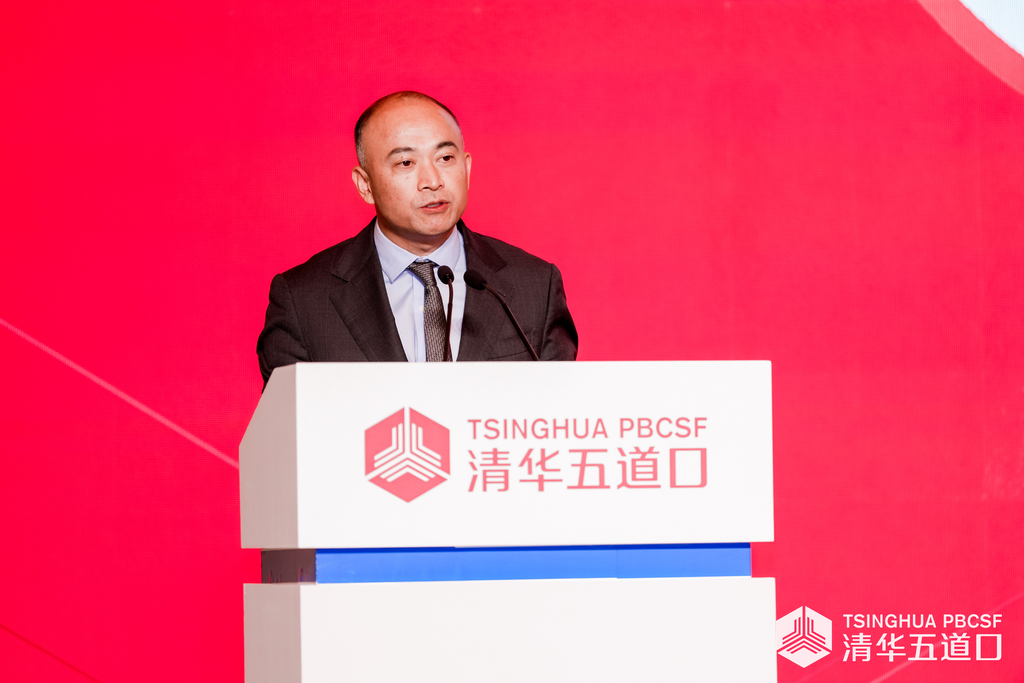
Photo: Miao Yanliang
Miao Yanliang, Senior Managing Director and Chief Strategist of China International Capital Corporation (CICC), noted in his comments that the international monetary system is often the slowest-moving part of global order changes. He observed that since 2015, global official foreign exchange reserves have stopped growing rapidly, due to rising policy spillovers and uncertainty from the core currency issuer and the strengthening economic strength of emerging economies, especially China. He emphasized that the essence of money is trust, not resources or manufacturing capacity. Promoting renminbi internationalization requires five actions: first, enhancing the flexibility of the exchange rate formation mechanism while keeping the renminbi exchange rate basically stable at an adaptive and equilibrium level; second, increasing the supply of offshore renminbi safe assets, moderately expanding the supply of government bonds and high-grade renminbi bonds; third, leveraging China’s trade status to enhance the role of renminbi settlement; fourth, raising the status of renminbi as a pricing currency, gradually enhancing renminbi pricing and price formation capabilities in sectors with comparative advantages and industrial chain influence; fifth, coordinating the development of onshore and offshore renminbi markets, as synergistic development provides a solid institutional foundation for renminbi internationalization.
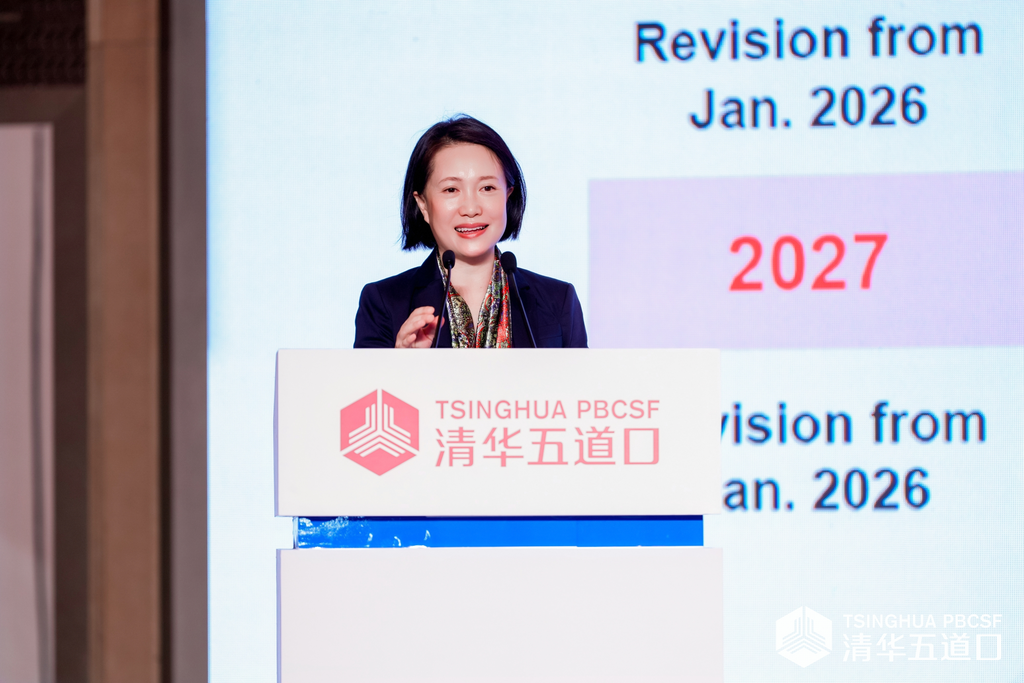
Photo: Sally Chen
Global Financial Stability Report – Global Financial Markets: The Shock of the Middle East War and Amplification Mechanisms
Sally Chen, IMF Resident Representative to Hong Kong Special Administrative Region, released the Global Financial Stability Report. She noted in the report that after the outbreak of the Middle East war, Brent crude oil prices experienced significant volatility, market-implied inflation rose notably, and the VIX volatility index increased sharply. In terms of market performance, the report shows that markets that had performed well earlier suffered greater losses after the war broke out. Futures markets indicated that the market generally viewed the energy price surge as a short-term phenomenon.
Chen highlighted four main categories of financial stability risks. First, bond market fragilities: inflation pushed up bond yields, and against a backdrop of high debt, higher rollover risks and more sensitive investors could exacerbate inflation shocks; banking systems hold large amounts of central government debt, and rapid repricing of sovereign bond prices could expose sovereign-bank nexus risks. Second, emerging markets under pressure: according to the report, capital outflows have been substantial since the outbreak of the war, with assets of weaker emerging markets sold off more and hard currency sovereign bond spreads widening. Third, high and concentrated asset valuations: advanced equity markets are highly valued and concentrated, and emerging market asset valuations have also risen, particularly in sovereign and corporate spreads. Fourth, amplification channels through financial vulnerabilities: cross-border claims of nonbank financial intermediaries account for a relatively high share, with nearly half of global bank exposures to nonbank financial institutions being cross-border; the exuberance in options and leveraged ETFs could amplify equity market volatility; hedge funds have significantly expanded their positions in bond and emerging markets; the $4 trillion private credit market is experiencing modest credit quality deterioration and redemption pressures in semi-liquid funds; the phenomenon of “circular financing” in artificial intelligence warrants attention; during bear markets, the concurrent sell-off of stocks and bonds has become more common and larger in magnitude. She emphasized that, unlike tariffs, the war cannot be resolved by unilateral actions and requires multilateral coordination. Current financial stability risks are elevated, and policymakers need to act decisively, including by providing accessible liquidity facilities, rebuilding fiscal buffers, implementing globally agreed prudential banking standards, and strengthening oversight of nonbank financial intermediaries.
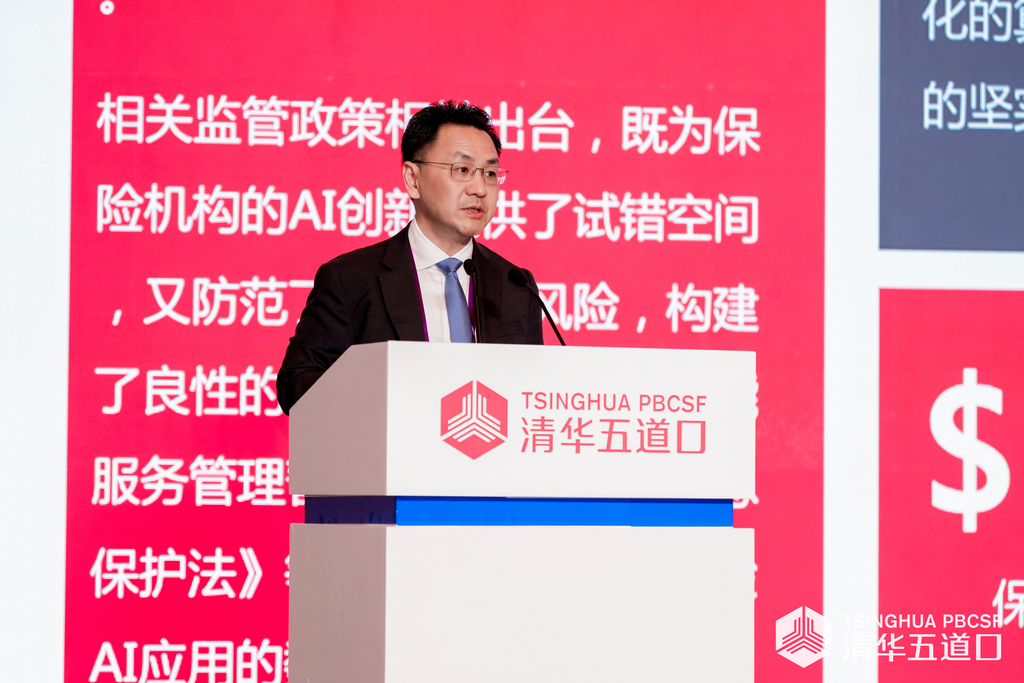
Photo: Wei Chenyang
AI-Driven Innovation in the Insurance Industry
Wei Chenyang, Director of the Research Center for China Insurance and Pension Finance at Tsinghua University PBC School of Finance (Tsinghua PBCSF), released the AI Insurance Industry Application Innovation White Paper. He pointed out that artificial intelligence is rapidly integrating into all areas of economic and social development. For the insurance industry, AI is no longer just an efficiency-enhancing tool, but is profoundly affecting business models, service methods, risk management systems, and industry governance logic. In the second half of 2025, the Research Center invited Zhou Yanli, former Vice Chairman of the China Insurance Regulatory Commission, to conduct thematic research in Beijing, Shanghai, and Shenzhen, gaining in-depth understanding of the exploratory practices of more than ten insurance institutions and technology companies. The White Paper systematically reviews the application foundations, typical scenarios, practical results, real challenges, and future paths of AI in the insurance sector.
According to the White Paper, the reshaping of the insurance industry by AI comes from three forces: policy guidance, technological generational leap, and changes in social demand. The technological foundation is summarized into four core pillars: data and knowledge, computing infrastructure, model capabilities, and safety and compliance. In terms of application progress, AI has deeply penetrated multiple links of the insurance value chain – in the front office for sales support and intelligent customer service; in the middle office for product development, intelligent underwriting, claims, and fraud detection; and in the back office for auditing, finance, and R&D collaboration. The value of AI in insurance includes cost reduction and efficiency improvement, quality enhancement and growth upgrade, risk management strengthening, and customer experience optimization. At the same time, the industry still faces challenges in technology, data, organization, talent, and compliance governance; large models may suffer from hallucinations and output instability, and many institutions struggle with data silos, knowledge silos, and a shortage of interdisciplinary talent. Future trends include three directions: the technology base moving from functional support to intelligent native, business models moving from point-wise efficiency gains to systematic value creation, and the external ecosystem moving from intra‑institutional efficiency gains to cross‑entity collaboration.
In the roundtable discussion, Wang Mengya, Assistant General Manager of the Digital Finance Department / Digital Transformation Promotion Office, China Reinsurance (Group) Corporation, pointed out that data and knowledge foundations, model governance, and risk control are the most urgent breakthrough points. Reinsurers face data with multi‑source and heterogeneous characteristics and need to break data silos and build high-quality datasets, as well as establish a model lifecycle governance system. As the industry’s risk aggregator, reinsurers can distill cross-market insights into reusable AI capabilities to empower primary insurers. Jia Jinpeng, General Manager of the IT Department, Ping An Life Insurance Company of China, Ltd., summarized the key elements as “bottom line, foundation, and key”: the bottom line is compliance, accuracy, and traceability; the foundation is data and knowledge; the key is deep business participation and active collaboration – business participation is an essential factor for AI projects to take root and grow. Liu Jun, General Manager of Financial Solutions, Volcano Engine, proposed a “4321” allocation of effort: 40% for business process reengineering and knowledge/data sorting, 30% for organization and mechanisms, 20% for engineering (models, knowledge, agents, security), and 10% for model optimization and tuning. He argued that the business models and organizational structures of the insurance industry are relatively traditional, while AI is a new technology – the adaptation between the two is the most difficult point that needs to be overcome.
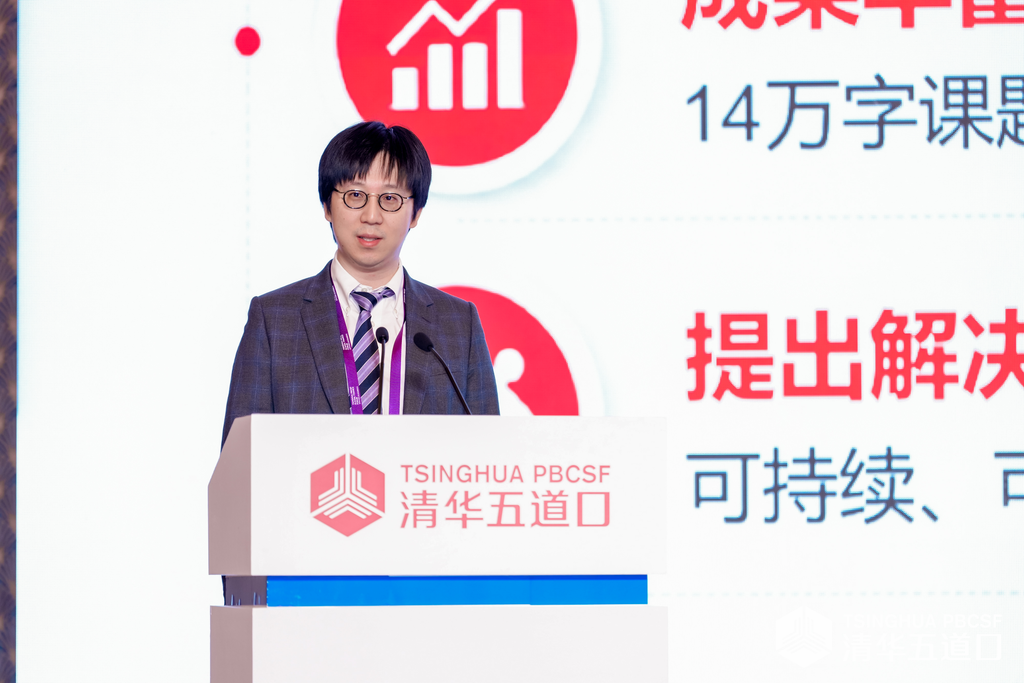
Photo: Guo Xiangyu
Financial Innovation in Urban Village Regeneration
Guo Xiangyu, Director of the Research,Research Center for Real Estate Finance at Tsinghua PBCSF, released the research report Financial Innovation in Urban Village Regeneration. He pointed out that China’s urban development is shifting from incremental expansion to a new phase focused on stock quality and efficiency improvement. On May 15, the State Council executive meeting approved the “15th Five-Year Plan for Urban Renewal,” emphasizing that urban renewal should be placed in a prominent position. Aligning with national strategic needs and addressing industry pain points, the Research Center identified financial innovation in the urban renewal sector as a key research direction and launched this special project in early 2025. After more than a year of research and refinement, the release of the project’s findings is timely, both responding to the country’s pressing concerns regarding deepening urban renewal and filling a gap in think tank research on the construction of a financial system for urban village regeneration in China.
Guo pointed out that the essential difficulty of urban village regeneration is a financial problem. Urban village regeneration requires the establishment of business models and financial systems that are compatible with the new phase of development. In terms of business models, the development model should be shifted from debt‑driven to equity‑driven, and from heavy‑asset construction to light‑asset operation. In terms of financial systems, it is necessary to distinguish the nature of project funds: strengthen policy tools to support public‑interest components, encourage market tools to invest in profitable parts, and achieve exits through instruments such as REITs. Guo emphasized that policy support is a prerequisite for the formation of new business models and financial systems. To that end, the report puts forward three specific recommendations: first, optimize land rules to adapt to the needs of regeneration; second, improve the alignment of financial instruments with regeneration requirements, leveraging the strategic position of the multi‑tiered REITs market in the urban renewal sector; third, clarify the division of responsibilities among various actors, forming a capable government with central‑local coordination while fostering an effective market with clearly defined rights and responsibilities among market participants. Looking ahead, a “full‑cycle, category‑specific, and sustainable” financial ecosystem is expected to become a key lever to solve the challenges of urban village regeneration and unlock new vitality in cities.
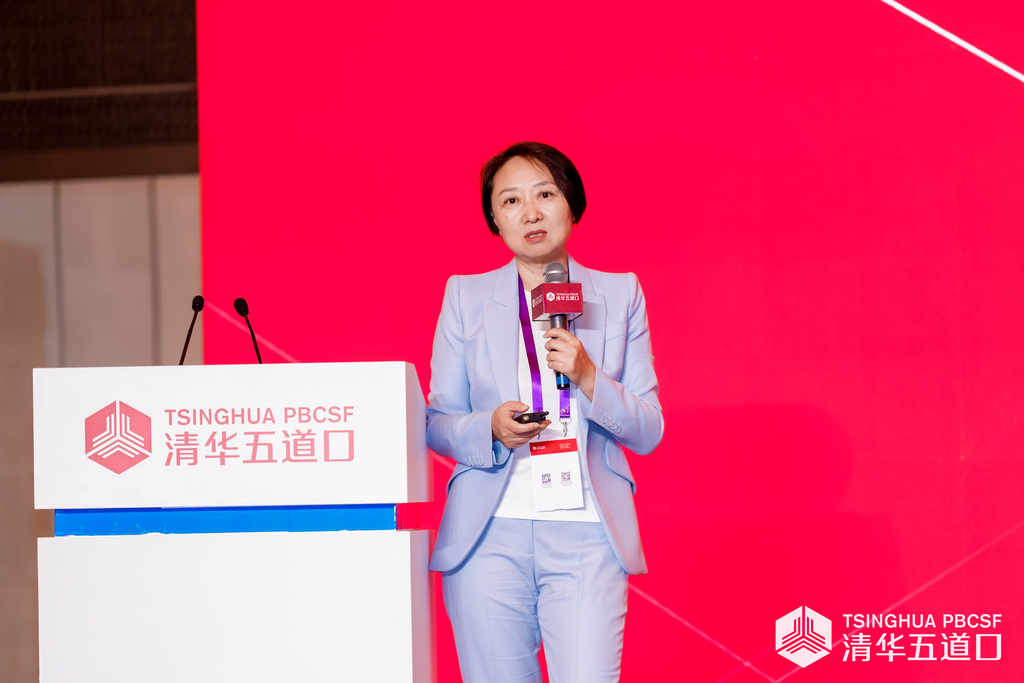
Photo: Wang Xian
Financial Regulation: Theory and Practice & The Games in Regulation: A Brief History of Financial Regulation Over Four Centuries
Wang Xian, Vice Chair of the National Institute of Financial Research at Tsinghua University, and Director of the Research Center for Listed Company at Tsinghua PBCSF, released two financial regulation books. The already published Financial Regulation: Theory and Practice takes the economics of regulation as its foundation, deriving the necessity of regulation from market failures while also emphasizing the need to prevent regulatory failures. The book is divided into three parts: theoretical foundations, regulatory practices, and institutional evolution, systematically reviewing regulatory practices in banking, insurance, securities, and financial infrastructure, and comparing the evolution of regulatory systems in the UK, the US, and China. Citing the Tsinghua motto “Self-Discipline and Social Commitment,” she noted that financial practitioners wield enormous power to transfer assets and must possess high ethical standards and regulatory knowledge. The book has been called by students “a professional ethics course for financial practitioners.”
The forthcoming The Games in Regulation: A Brief History of Financial Regulation Over Four Centuries, as a companion volume, steps beyond pure theory to trace the evolutionary logic of financial regulation systems. Wang Xian pointed out that financial regulation is not the product of theoretical construction but a game equilibrium, with participants including lawyers, judges, and politicians. The book narrates 400 years of financial regulatory evolution from the British Bubble Act of 1720 to 2026, covering the evolution of the UK from common‑law self‑regulation to the “twin peaks” regulatory system, the crisis‑driven federalization process in the US and its persistent “fragmentation” challenges, and the different regulatory paths of civil‑law countries such as France, Germany, and Japan. Spanning four centuries and covering five major economies, the book reveals how regulatory crises break old equilibria and create new ones, providing a grand historical perspective for understanding the dynamic formation of financial regulation.
Thus, the “Report and Achievement Release” thematic panel of the 2026 Tsinghua PBCSF Global Finance Forum concluded successfully. The six major reports and new books, focusing on international monetary system reform, global financial stability, AI application in insurance, financial innovation in urban village regeneration, and financial regulatory theory, responded multi‑dimensionally to the forum’s theme “Global Financial Governance in a Changing World: New Challenges, New Opportunities, New Developments,” providing solid research support for policy formulation and industry practice.